Germany is stepping up its efforts to establish itself as one of the world's leading centres for artificial intelligence (AI) and robotics, recognising that these technologies will play a decisive role in the future of economic
growth, industrial competitiveness and national security. Against this background, the Digital Summit 2026, held in Berlin under the auspices of the Federal Government and Chancellor Friedrich Merz, has become an important platform for discussing the country's technological ambitions and its position in the global digital race.
The conference, organised by the Federal Ministry for Digital Transformation and Government Modernisation, took place on 2 November under the theme “Shaping AI: Safe, Sovereign, Competitive”. It brought together representatives of politics, business, academia and civil society to examine the opportunities and risks associated with artificial intelligence, as well as questions of digital sovereignty, technological security and Europe's competitiveness.
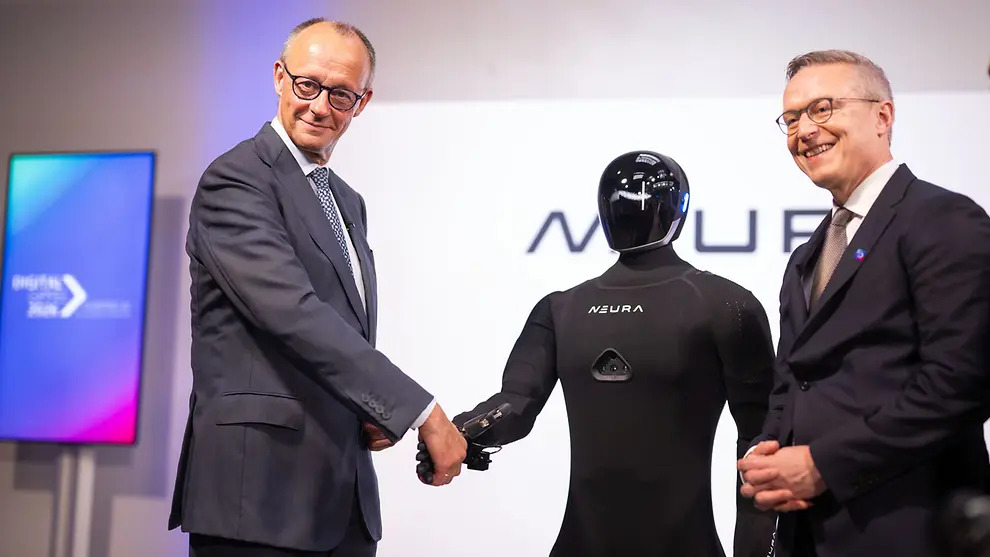
The summit also provided an opportunity to demonstrate Germany's growing capabilities in robotics. During his visit, Chancellor Friedrich Merz examined a robot manufactured by German company NEURA Robotics, highlighting the importance of combining artificial intelligence with advanced industrial engineering. Germany has considerable experience in automation and industrial manufacturing, and the government believes that integrating AI into these sectors could give German companies a significant competitive advantage.
Addressing the conference, Merz called for faster progress in Germany and Europe in developing and applying digital technologies. He stressed that the country must become more effective at turning technological research and innovative ideas into practical solutions. At the same time, he emphasised that technological transformation should be guided by European values, with people rather than technology remaining at its centre.
The Chancellor believes that Germany has the potential to become a global leader in industrial artificial intelligence. The country's strong industrial base, engineering expertise and research capabilities could provide an important foundation for this ambition, particularly in manufacturing, automation and robotics.
Federal Minister for Digital Transformation Karsten Wildberger also underlined the importance of strengthening Europe's technological independence. He argued that Germany needs a reliable framework that encourages innovation, improves digital sovereignty and enables European companies to compete more effectively internationally.
An important element of the summit was the presentation of the Federal Government's strategy for turning Germany into an AI nation by 2030. An inter-ministerial AI task force has developed a programme containing 18 key measures covering infrastructure, technological innovation, security, specialist expertise and the development of new applications.
The government has also established measurable targets. By 2030, it expects at least 80 per cent of large companies and 55 per cent of small and medium-sized enterprises to be using artificial intelligence. The authorities also aim for AI-related activities to account for more than 10 per cent of Germany's economic output. Meanwhile, 90 per cent of federal authorities are expected to use at least one AI application in their core operations.
These ambitions reflect Berlin's understanding that artificial intelligence is no longer simply a technological issue but a strategic factor influencing economic prosperity, public administration and international competitiveness. Germany wants to ensure that its businesses and institutions do not become dependent on technological solutions developed elsewhere, particularly amid growing competition between the United States, China and Europe.
The 2026 gathering follows the previous year's Digital Summit, which focused on European digital sovereignty and was organised in cooperation with the French Government. That meeting addressed data protection, data sovereignty, digital infrastructure and the development of a more independent European technological ecosystem. The latest summit builds on these discussions, shifting attention towards the practical implementation of artificial intelligence.
Germany's ambitions also have a broader European dimension. Berlin recognises that individual European countries cannot easily compete with major global technology powers without closer cooperation, coordinated investment and a stronger innovation environment. Cooperation with France, the European Commission and other international partners is therefore expected to remain an important part of its digital strategy.
Ultimately, the Digital Summit 2026 demonstrated that Germany intends to play a much more influential role in shaping the future of artificial intelligence and robotics. Its objective is not only to adopt new technologies but also to develop them domestically, strengthen industrial production and establish a secure and competitive European digital economy. The government's 2030 targets will provide an important measure of whether Germany can translate these ambitions into tangible economic and technological achievements. Photo by bundesregierung.de