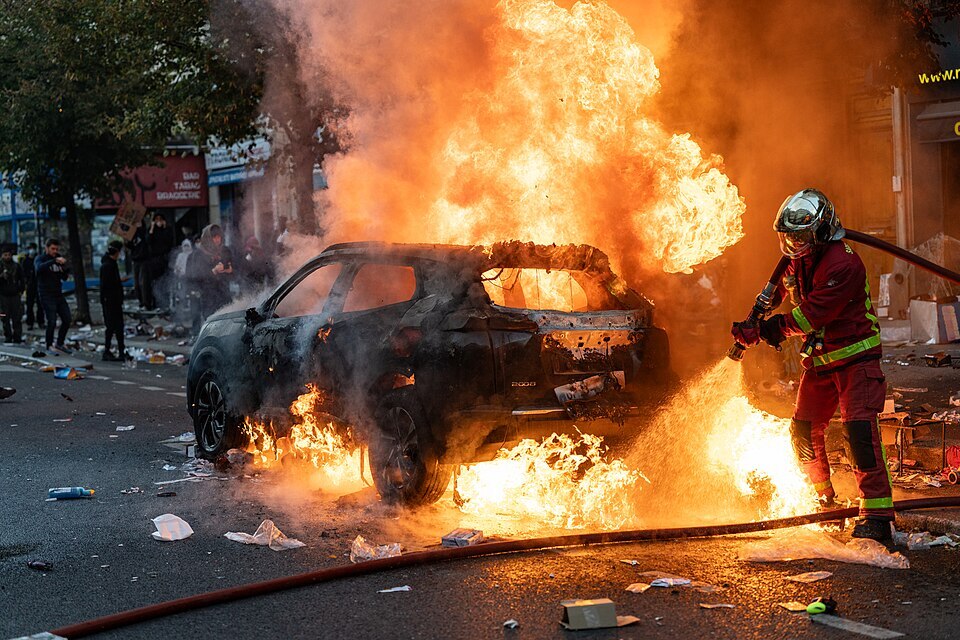
French President Emmanuel Macron is set to visit Marseille following weeks of demonstrations and unrest that have shaken the country, as the government faces growing pressure to restore public order and respond to
public anger over the cost of living and conditions in schools.
The president’s visit to France’s second-largest city comes after nationwide protests on October 17 escalated into some of the most serious episodes of rioting in recent years. Demonstrations continued over the weekend, with clashes between protesters and security forces reported in Paris and several other cities.
The unrest has created a significant political challenge for Macron, with a presidential election approaching in six months. Opposition figures have accused the government of failing to maintain public order, while the authorities have acknowledged shortcomings in security and intelligence arrangements that contributed to the scale of the violence.
Marine Le Pen, the far-right leader and leading contender in the presidential race, has sought to capitalise on public frustration. Speaking at an election rally in Orléans on Sunday, she pledged to restore the rule of law if elected. Recent polling suggests that the unrest has strengthened her political position as criticism of the government intensifies.
Macron to meet businesses affected by riots
During his visit to Marseille on Monday, Macron is expected to visit the city hall, which was damaged during the October 17 disturbances. He will also meet local business owners whose shops were targeted by looters and vandals.
The presidency said the visit would include an opportunity for Macron to recognise the work of police and other security personnel involved in restoring order.
A presidential aide said the trip was intended to demonstrate that the state remained present and committed to protecting citizens and public institutions.
The effects of the violence were still visible in Marseille’s city centre on Monday morning, where numerous shopfronts remained covered with protective boards ahead of the president’s arrival.
Authorities had increased security measures for Saturday’s demonstrations in an effort to prevent a repeat of the earlier disorder. Interior Minister Laurent Nuñez described the latest protests as more manageable than those held a week earlier, although violence continued in several locations.
Nuñez said 1,435 people had been arrested in connection with the latest weekend of demonstrations. Speaking to BFMTV on Monday, he said the authorities had maintained control of the situation and that there had been no major incidents, despite what he described as a high level of violence directed at security personnel.
According to the interior minister, 267 police officers and gendarmes were injured, alongside 150 demonstrators. Three protesters sustained serious injuries in incidents in Toulouse, Reims and Clermont-Ferrand.
Student protests fuel wider discontent
The current wave of unrest grew out of weeks of student demonstrations demanding improvements to school facilities and learning conditions. The movement expanded after several teenagers were seriously injured and thousands of people were arrested during the protests.
Police tactics, particularly the response to school blockades organised by students, have attracted criticism from campaigners and opposition figures. Allegations of excessive force have helped broaden the demonstrations into a wider expression of dissatisfaction with the government, encompassing concerns about household expenses, policing and public safety.
Prime Minister Sébastien Lecornu was scheduled to meet student representatives in Paris on Monday. Education Minister Édouard Geffray and Higher Education Minister Philippe Baptiste were also due to participate, with the two ministers expected to address the media following the discussions.
Macron held talks with representatives of secondary school pupils last Friday. However, student leaders left the meeting urging their peers to continue demonstrating until the government presented specific measures addressing their demands.
The planned discussions with Lecornu are therefore likely to be closely watched for signs that the government is prepared to offer concrete commitments rather than general assurances.
Political pressure mounts ahead of election
The demonstrations have unfolded against an increasingly tense national backdrop. With the presidential election approaching, the government faces the challenge of addressing legitimate public grievances while preventing further violence and damage to public property.
Le Pen’s campaign has placed law and order at the centre of its message, seeking to present the unrest as evidence that the authorities have lost control. Her rising support has added to pressure on Macron and his administration to demonstrate that they can restore stability.
The crisis has also been compounded by a deadly shooting outside Paris last week. One person was killed and five others were wounded, including a 12-year-old girl. Macron described the incident as a racist terrorist attack, noting that most of those affected came from foreign backgrounds.
The combination of violent demonstrations, concerns about policing and the fatal shooting has intensified debate over security, social tensions and the government's ability to protect communities.
Macron’s visit to Marseille and the prime minister’s talks with student leaders represent parallel attempts to address the immediate consequences of the unrest. Whether these efforts will ease public anger remains uncertain, as the authorities confront demands for better school conditions, concerns over the cost of living and calls for stronger protection of public order. Photo by Jorge Jaramillo , Wikimedia commons.